To: IPSY's lifecycle team
Re: End-to-end user test · Postmarked July 2026
An Average Marketer · Letter No 4
IPSY says it uses 500 data points a month to match me with beauty. It never asked the one that decides a foundation match.
IPSY invented this category, and the Beauty Quiz is genuinely impressive data collection — 15 screens covering skin depth, shade preferences, and desired frequency across 27 product categories. So I signed up as a real user: took the quiz on two accounts, sat in the drip for two weeks, subscribed, and bought from the members-only shop. The pattern I found: the machine that collects the data and the machine that sends the email have never met. Fourteen emails used my name once and my quiz answers never — and ten minutes after I paid, the shop sold me concealer labeled by undertone code, the one attribute the quiz never asked.
15
Quiz Screens
Skin depth, eye and hair color, shade preferences, frequency matrices for 27 product categories, brands, concerns — richer data than most beauty brands ever get.
0
Undertone Questions
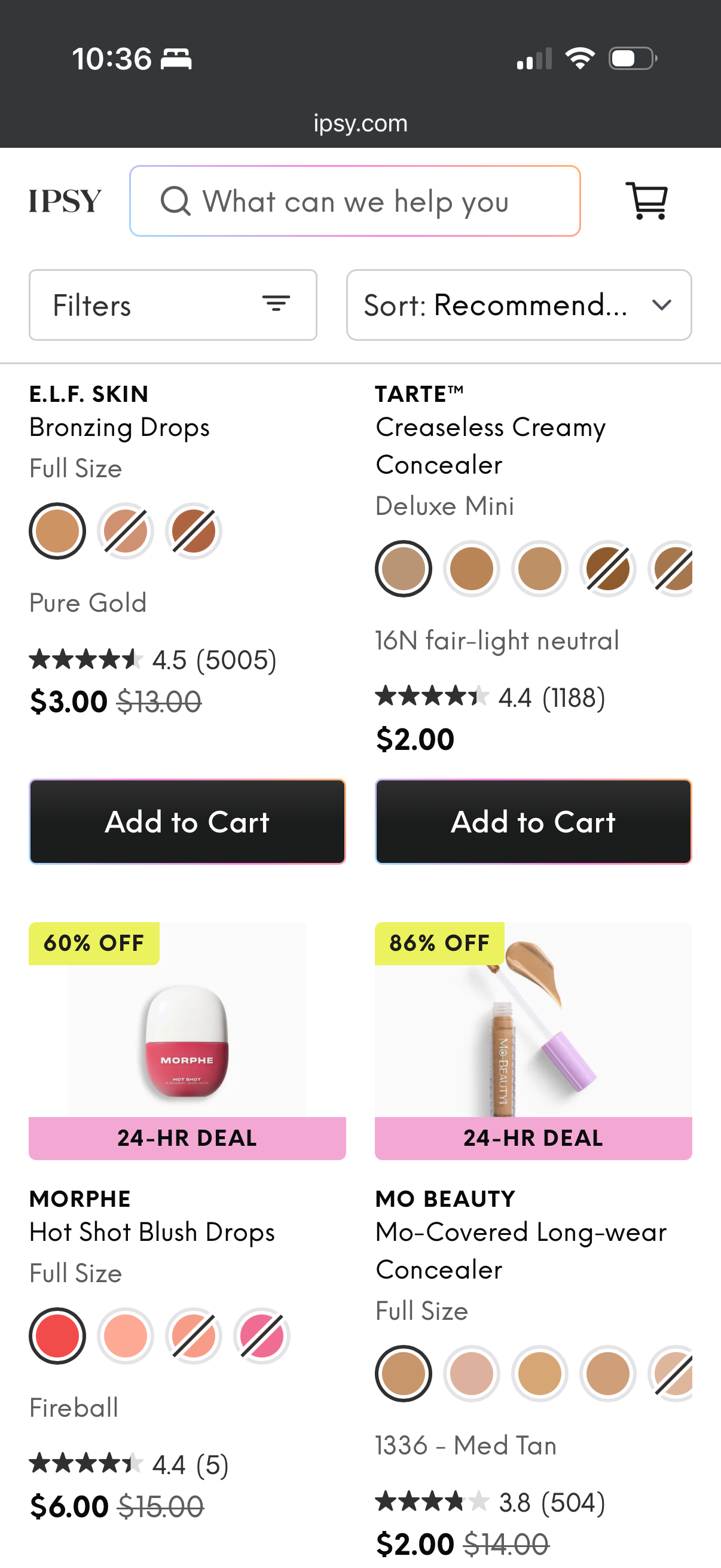
The quiz asks how often I want foundation and concealer — and never asks warm, cool, or neutral. Then the shop sells SKUs coded "16N fair-light neutral."
12 of 14
Emails That Sell
Discounts see-sawed $10 → $5 → $10 across the sequence. My name appeared once, as "HOI,". My quiz answers appeared in zero emails.
What you'll learn in this teardown
- How to audit a beauty quiz for data it collects but never acts on — and the one question it's missing
- What an uncoordinated offer ladder looks like from a single inbox, expired fine print included
- How to read a checkout for deferred charges and price-presentation trust leaks
01 — The Beauty Quiz
27 product categories. 8 skin-tone swatches. Not one undertone.
The quiz took 8.5 minutes: frequency matrices for every product type, shade preferences for eyes, lips, and blush, ~30 brand affinities, skin and hair concerns. The questions are good. Two structural gaps undermine the whole engine — the missing undertone question, and matrices that arrive pre-answered.
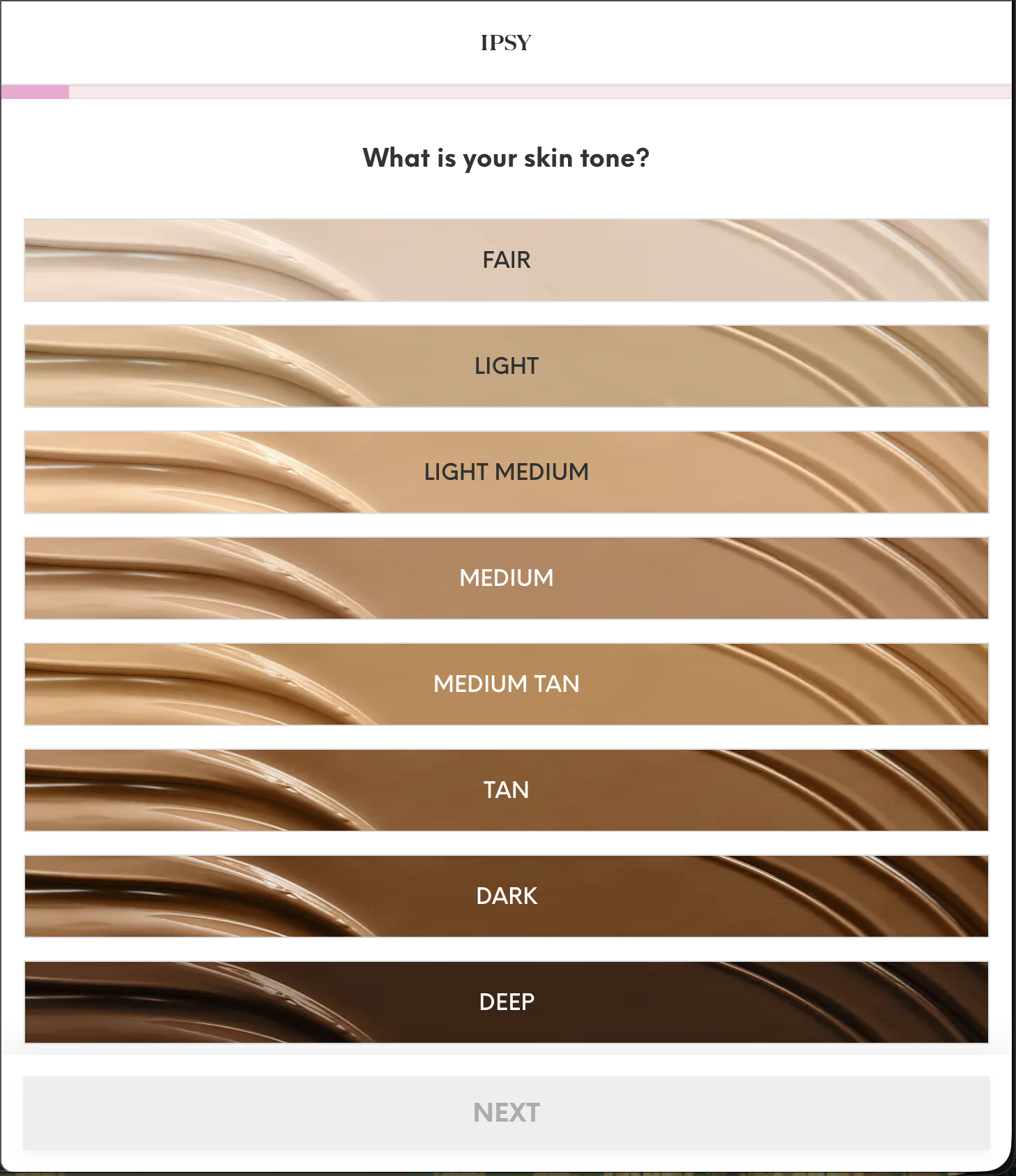
The only skin-color question in the flow: eight depth swatches, Fair to Deep. Depth without undertone can't match a foundation — the exact products the quiz then asks how often I want.
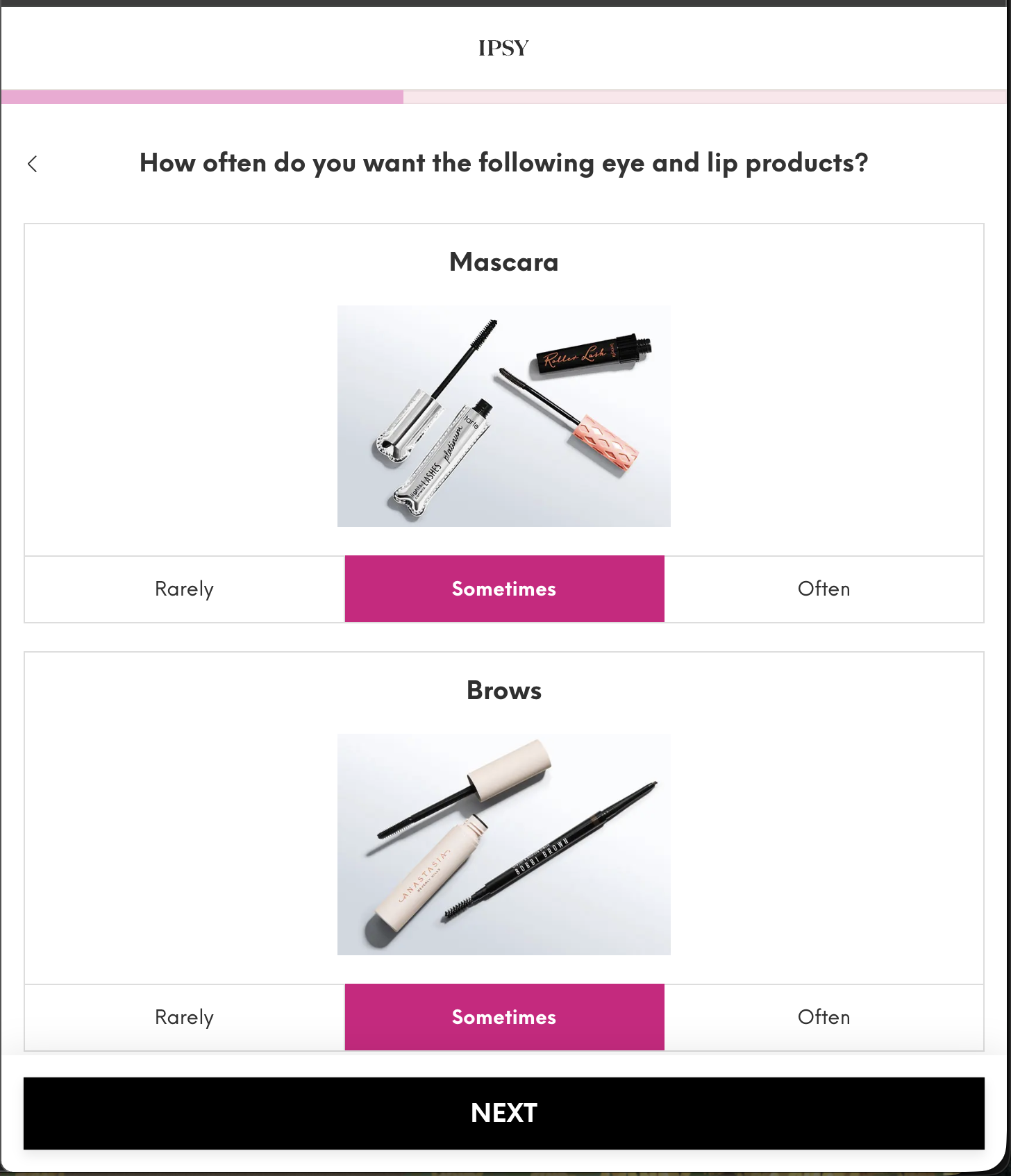
Every frequency matrix arrives pre-selected to "Sometimes." A user can click NEXT without touching a row — so the system can't tell a real preference from a skipped screen.
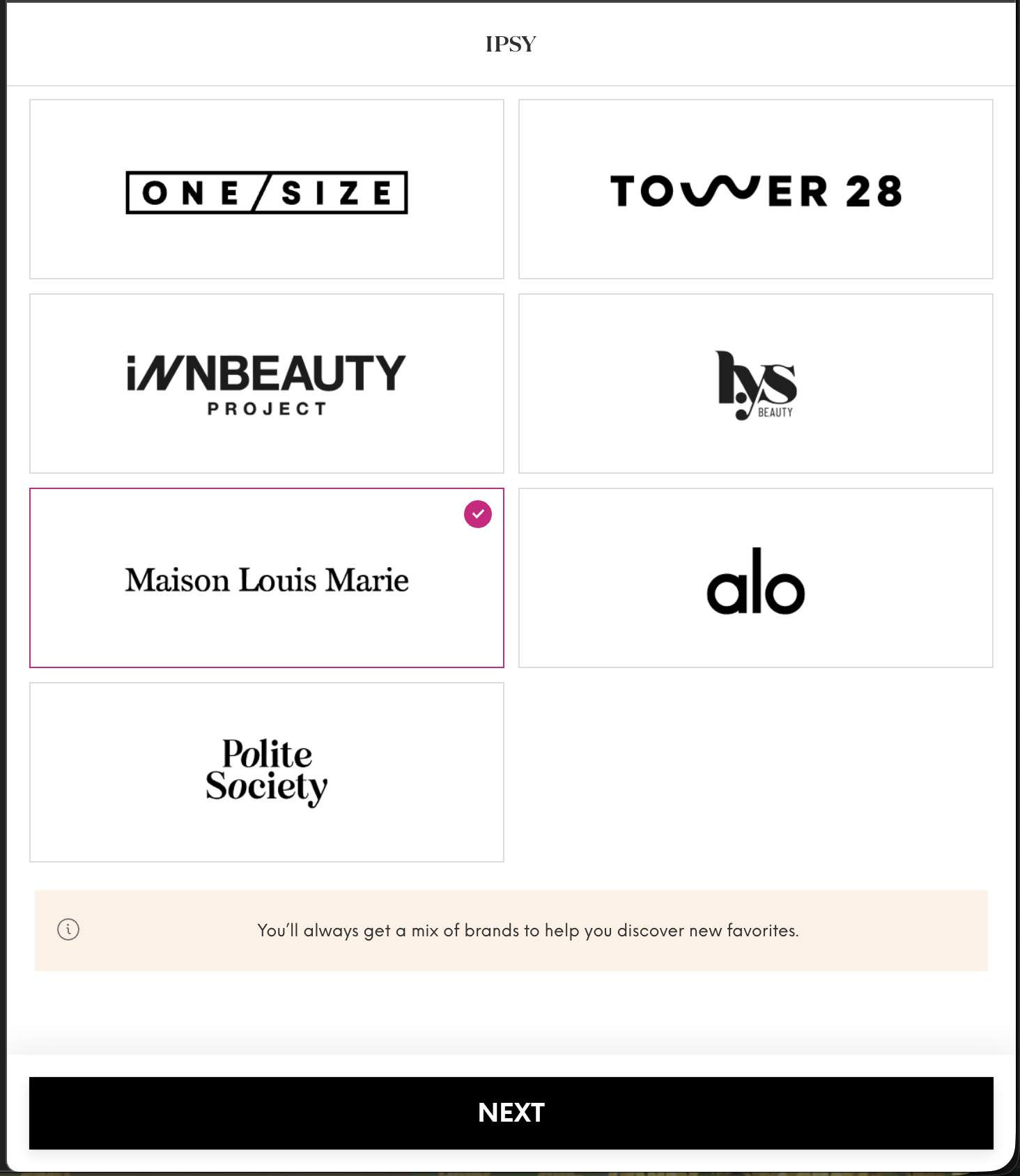
The flow's only expectation-setting line, after the brand picker: "You'll always get a mix of brands to help you discover new favorites." A hedge, not a promise — it pre-excuses ignoring the answer.
Fix 1 of 2
Add one screen: undertone, with a shade-match assist
The shop already merchandises undertone-coded SKUs — "16N fair-light neutral," "Med Tan" — so the taxonomy exists in the catalog. One quiz screen (warm / cool / neutral / not sure, with a vein-color helper) closes the loop between the data the algorithm needs and the complexion products it ships. This is the single cheapest input with the most downstream effect on "the bag felt made for me."
Fix 2 of 2
Unset the defaults on the frequency matrices
Pre-filled "Sometimes" rows pollute the dataset the entire curation engine trains on — a skipped screen and a considered "Sometimes" are indistinguishable. Require a touch per row (or a "skip this category" control) and the signal quality of every downstream match improves for free.
02 — Checkout
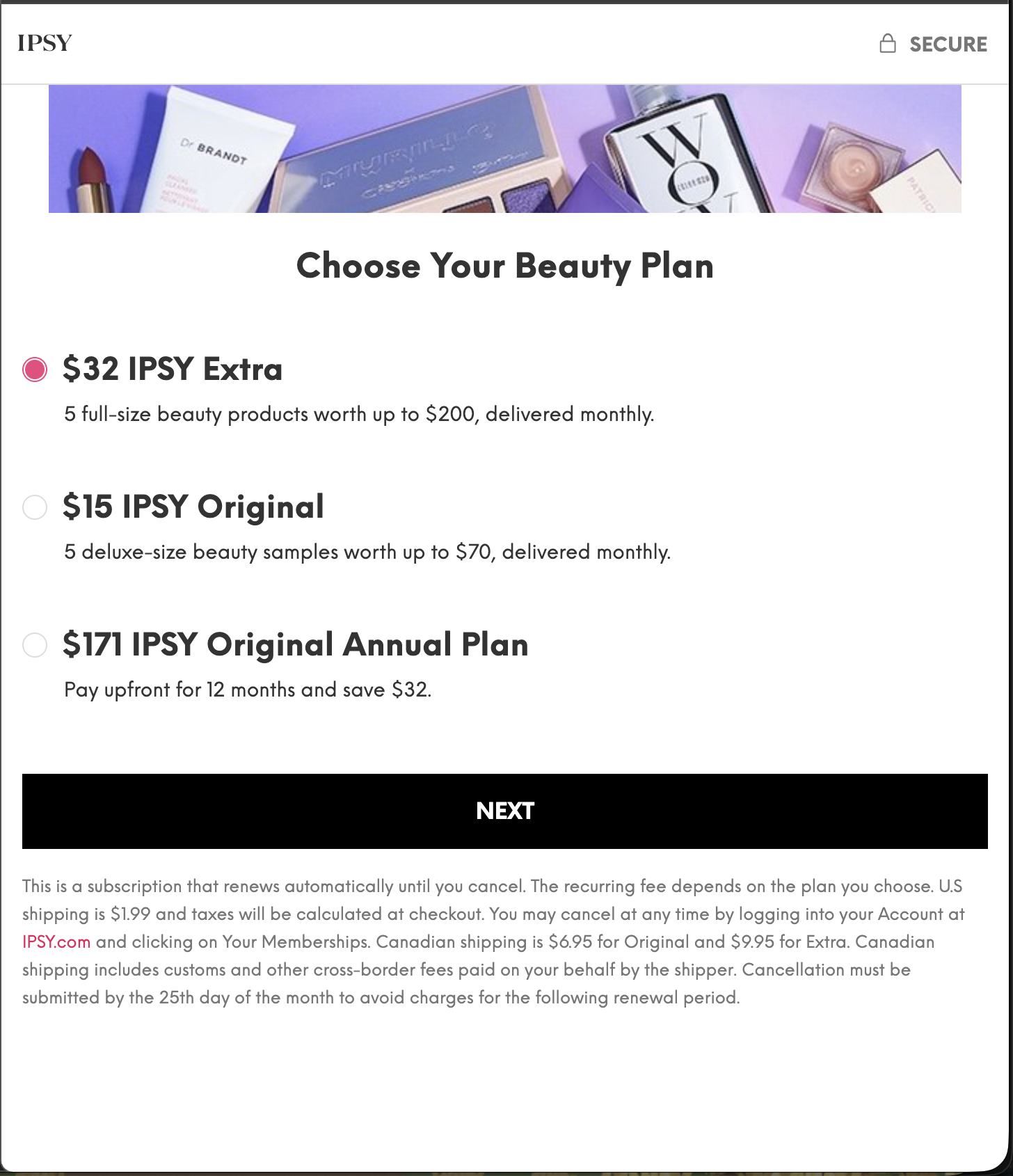
Three tiers, the priciest pre-selected — and the real first-cycle cost never appears as one number.
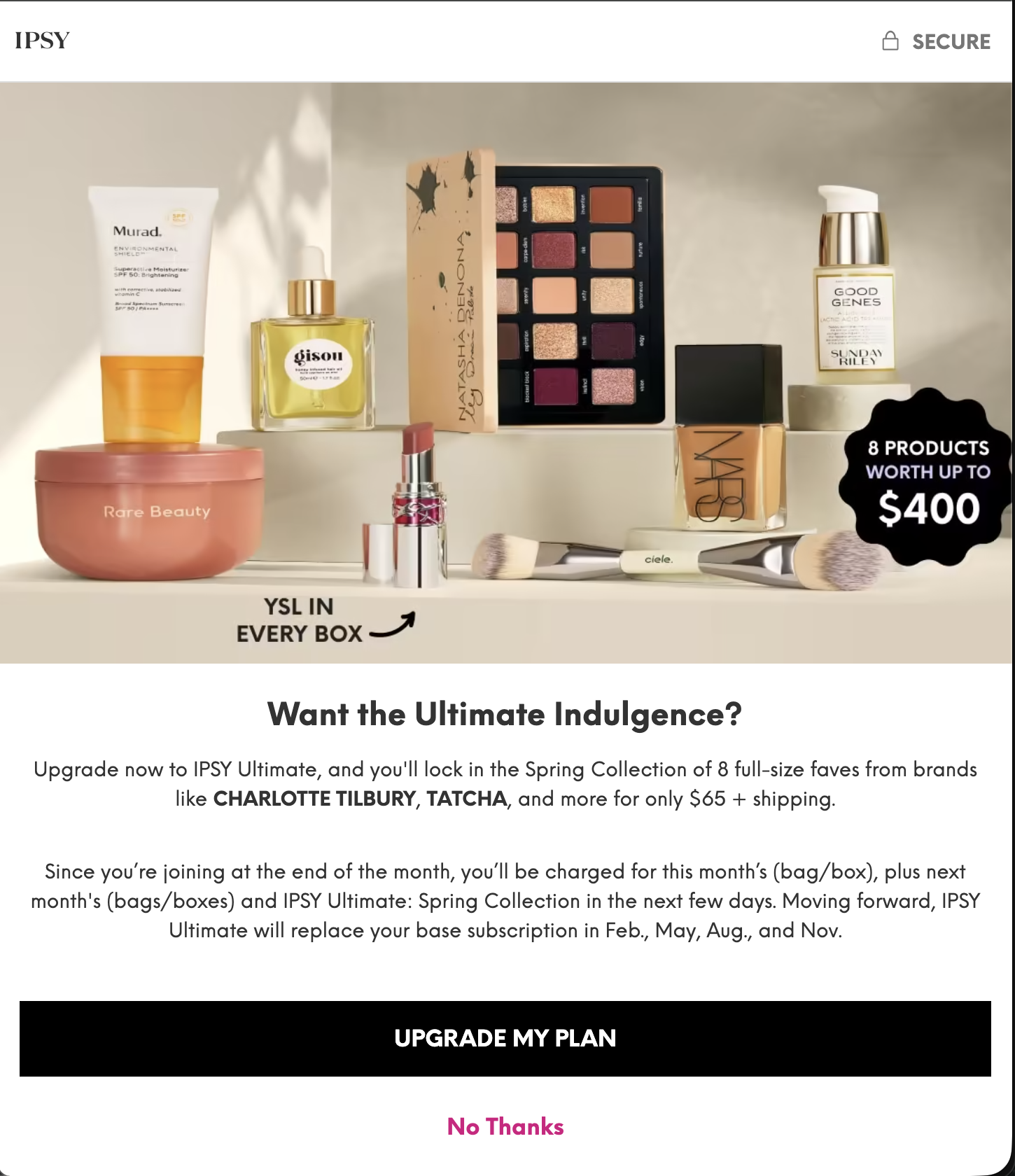
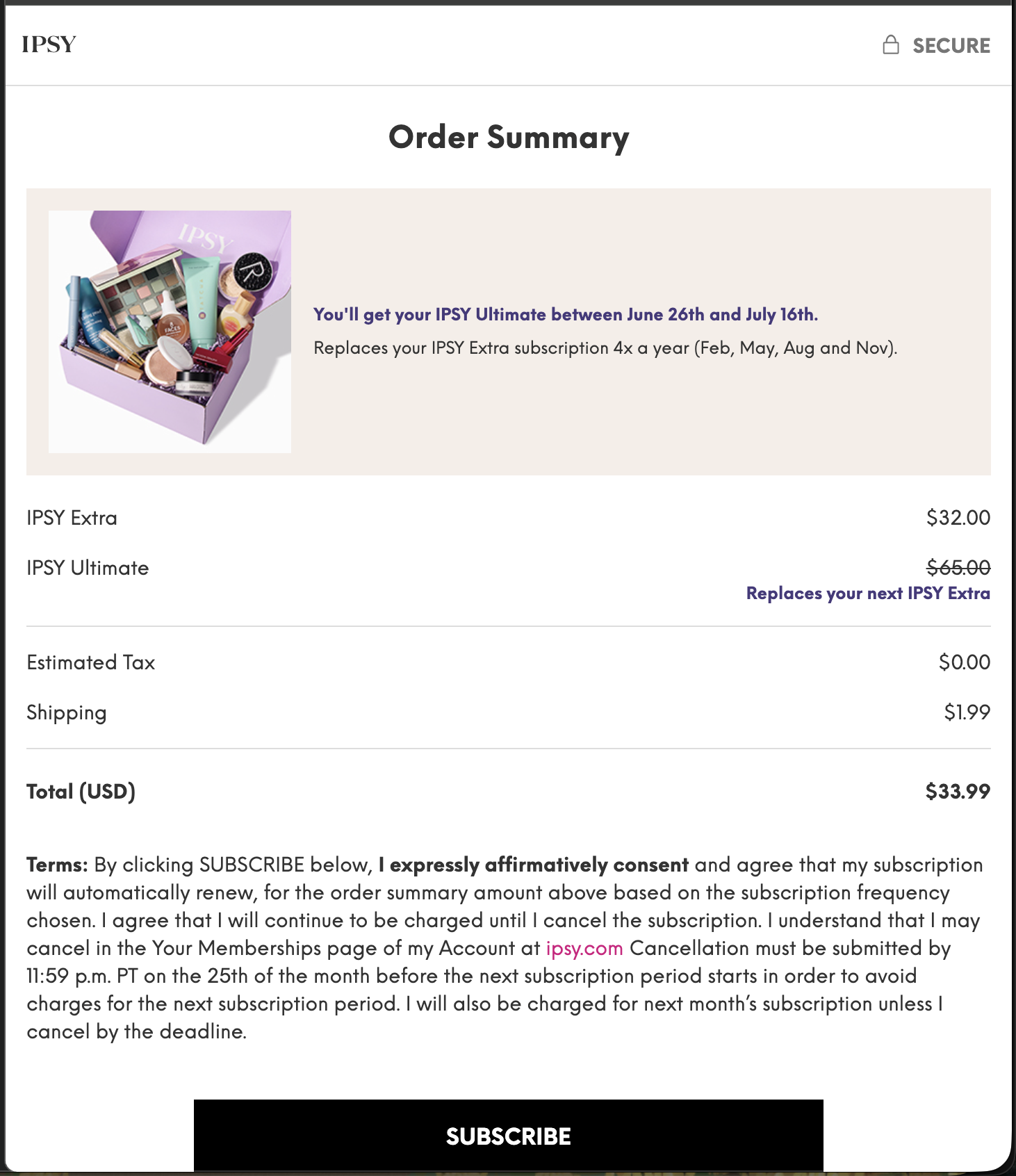
The plan picker defaults to $32/month Extra above the $15 Original. Before the address form, a full-page interstitial pitches the $65/quarter Ultimate. The order summary shows $33.99 due today — with the $65 struck through and deferred to "the next few days." Joining at the end of the month, the true near-term outlay approaches $99. That number appears nowhere.
The $32 Extra arrives pre-selected above the $15 Original. The annual plan's "save $32" claim only works if you count shipping into the comparison.
The Ultimate interstitial sells the "Spring Collection" — and buries a three-charge disclosure in body copy: this month's bag, next month's bag, and the $65 Ultimate, all "in the next few days."
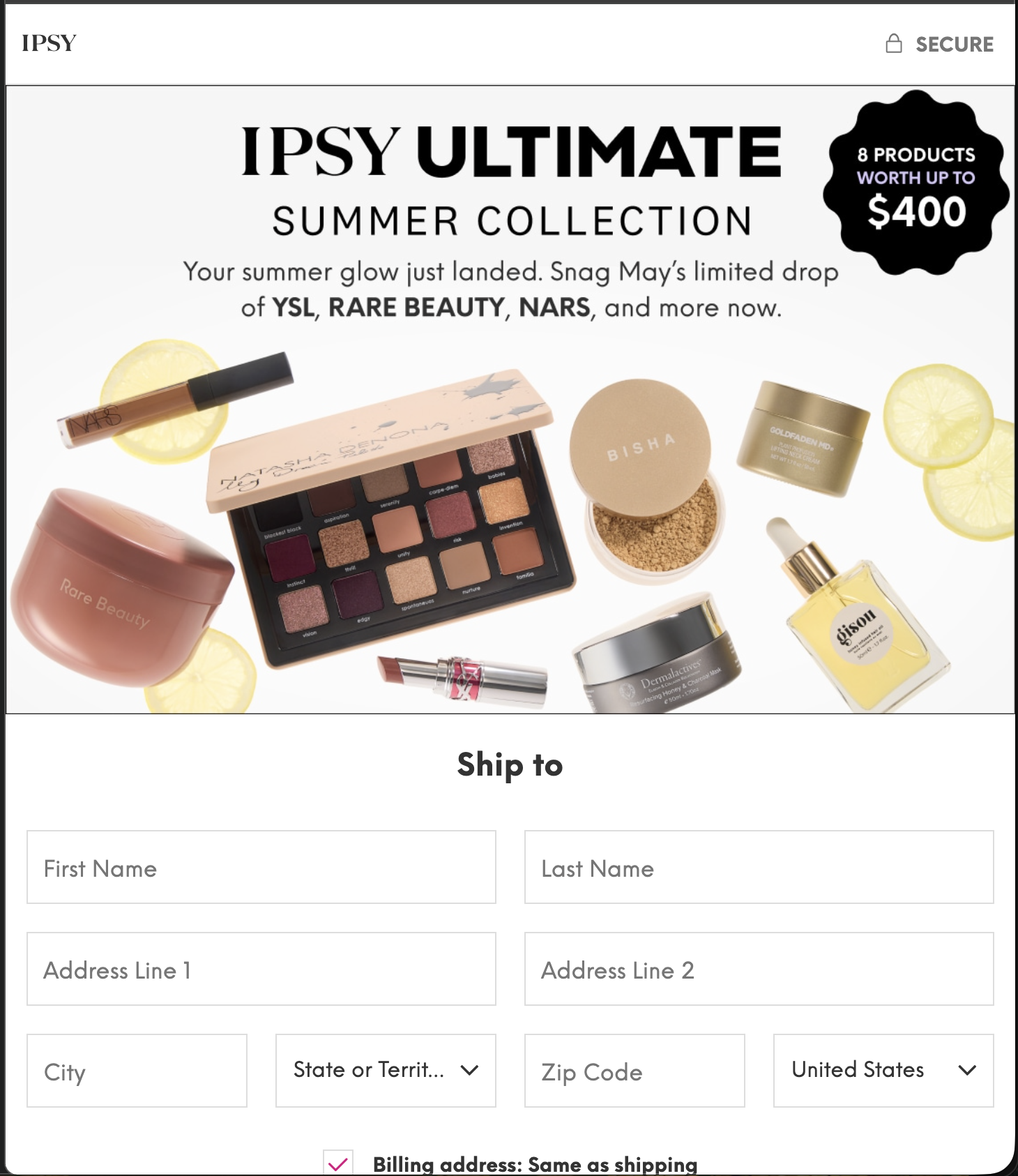
One screen later the same product is the "Summer Collection" — "May's limited drop," captured on June 25. Two seasons and a stale month, inside a single checkout.
The deferred total: $33.99 due today, the $65 Ultimate struck through with "Replaces your next IPSY Extra." Nothing on this screen adds up what the next few days actually cost. The consent copy is thorough — the arithmetic is the missing part.
Fix 1 of 1
One "what you'll pay and when" module — at checkout and in the confirmation
Three lines: today's charge, the charges coming this cycle (with dates), and the ongoing renewal price including shipping. Subscription checkouts live and die on billing trust, and regulators are watching negative-option flows closely — the brand that shows the math plainly wins the chargeback rate, the support volume, and the review pages all at once.
03 — The Email Program
14 emails in 14 days. My name appeared once. My quiz answers, never.
I took the quiz and stopped at the plan picker. What followed was two weeks of discount-led conversion pressure — offers that see-sawed between $10 and $5, three different expiry claims on the same free gift, and subject lines promising "made for you" over products the fine print admits are "illustrative only." Nearly every send fired at :38 past the hour — one quiz timestamp driving the whole drip.
"Confirm your membership"
Not a confirmation — a sales tease ("FINISH JOINING TO REVEAL YOUR PICKS") that also pitches the Shop and $3.50 Add-Ons before I've subscribed to anything.
Welcome tease
"Your IPSY is under construction"
One hour in: $5 off. Tomorrow's email doubles it — the ladder teaches a patient user to ignore any single offer.
Abandon #1
"Congrats! You got $10 off your first month ✨"
"Grab your bag now for a shot at must-haves" — the products are framed as a lottery, not as matches to the 15 screens of preferences I gave yesterday.
Abandon #2
"Yay! Get a FREE gift with your first bag" ⚠
"LIMITED TIME ONLY" banner over fine print reading "Offer expires 4/30/2026" — a deadline that passed six weeks before the send. Third email in 25 hours.
Gift #1
"Open to reveal your deal 🤩"
Third promo of the day. The "mystery" deal behind the reveal button is the same $10 I was given at 2:56 PM.
Abandon #3
"June's bag was made for you"
The subject claims made-for-me; the footer admits "Products shown are illustrative only." Half the email sells Add-Ons — to someone who hasn't subscribed.
Bag tease
"5 minis + a free gift when you join 💝" / "Your epic beauty haul is waiting" ⚠
Two sends, one day, conflicting offers: the morning email pushes the $45 gift ("Join by 6/26," "LOW STOCK" on a mystery item); the afternoon email regresses to $5 off — half the discount already granted on Day 1.
Collision
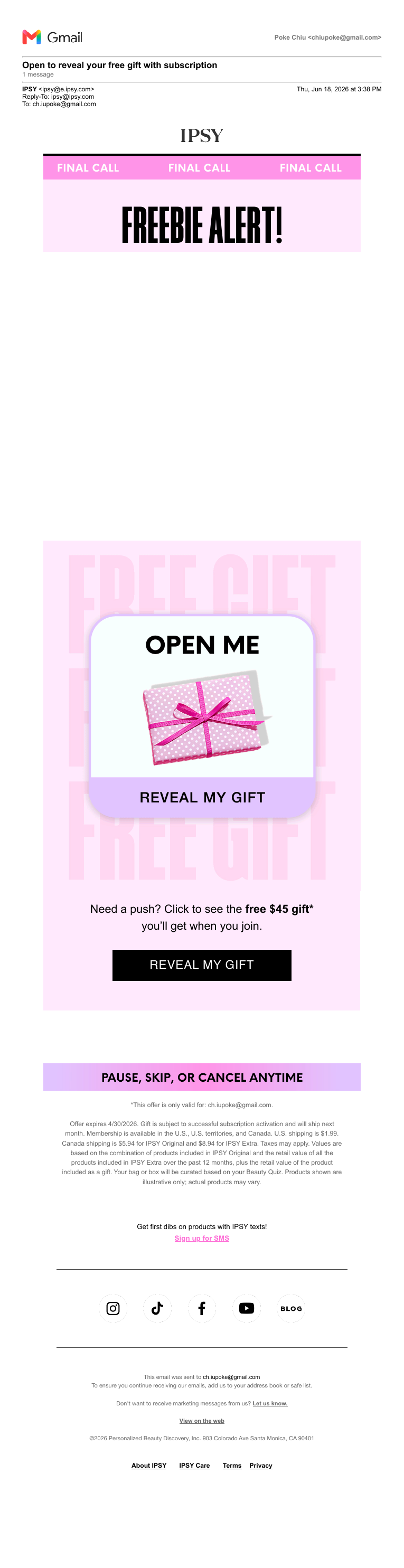
"Open to reveal your free gift with subscription" ⚠
"FINAL CALL" — above fine print that again reads "Offer expires 4/30/2026." The gift survives its own final call: the funnel keeps offering it for another week.
Gift #3
"Not ready to commit? 🤹"
Pause / skip / cancel reassurance — the closest the series comes to relationship content, and still led by "$10 OFF." This is the program's one objection-handling send. It works; there should be more like it.
Objection
"Last Chance for June's Picks"
A countdown timer expiring at ~3:21 AM. The deadline that actually matters — cancel by the 25th, 11:59 PM PT, to avoid next month's charge — appears nowhere in the email that converted me on the 25th.
Last chance
"Your IPSY order is in" — I subscribed
$7.67 for month one. Because I joined on the 25th, my window to cancel before month two closed 83 minutes later — the confirmation frames this as "you've locked in next month's bag with early access!"
Conversion
Day 1: "a shot at must-haves" — six stock products, none derived from the quiz completed 24 hours earlier.
Day 6: "FINAL CALL" urgency over fine print whose deadline passed on April 30 — six weeks before the send.
Day 13: the countdown email that converted me — silent on the one deadline that would cost me money 83 minutes later.
The Offer-Governance Problem
Three expiry dates for one gift, a $10/$5 see-saw, and expired fine print under "FINAL CALL" — this is structural, not cosmetic.
The same $45 gift carried "expires 4/30/2026" (already passed), "LIMITED TIME ONLY," and "Join by 6/26" across three sends. Discounts went $10 → $5 → $10 → $5 → $10 in eight days. No copywriter fixes this — it needs an offer ledger: one source of truth for every live offer, its expiry, and its place on a ladder that only escalates. That's a spreadsheet and a flow audit, not a replatform — and it ends the pattern where the program's own urgency claims train subscribers not to believe it.
04 — The First Ten Minutes as a Member
The headline says $15/month. The fine print says $16.99. The shop collected $17.56 before my bag shipped.
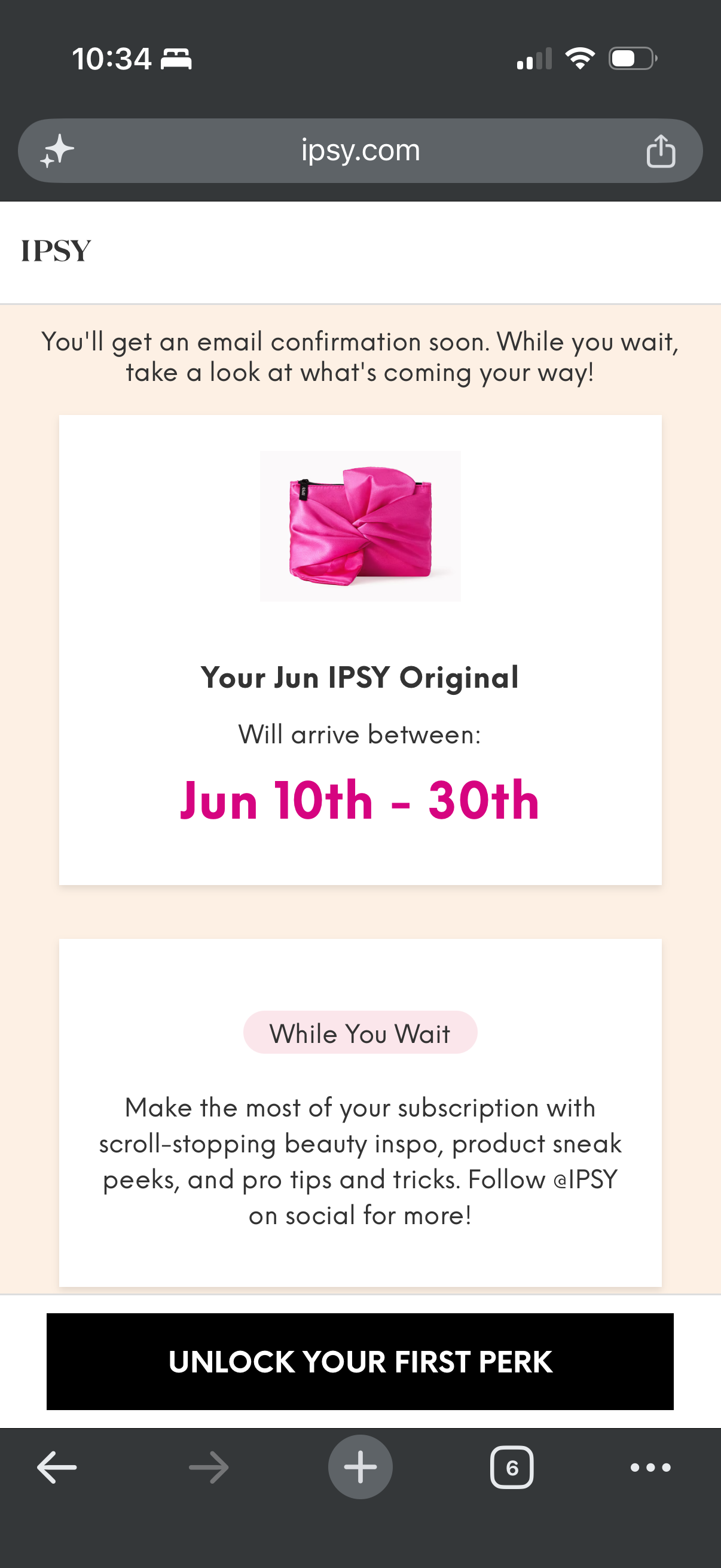
The confirmation email greets me as "HOI," — the only time any email uses my name, and it's my truncated legal name in all caps. Then the onboarding "perk" chain begins: perk one is the right to choose 1 of my 5 products (during the 20th–29th window); perk two is the members-only shop. Ten minutes after subscribing for $7.67, I'd spent $17.56 more.
The receipt: plan line says $15.00/month; the fine print renews at "$16.99 plus tax" — shipping silently folded in. Even the receipt carries three upsell modules.
Post-purchase: a 20-day arrival window ("Jun 10th – 30th") and a gamified "UNLOCK YOUR FIRST PERK" chain that begins before the confirmation email arrives.
The tell: the members-only shop sells concealers by undertone code — "16N fair-light neutral," "Med Tan" — with 24-HR DEAL banners, to a member whose undertone the quiz never asked.
The Public Record · Context, Not Verdict
4.8 stars where members join. 1.5–2.3 stars where they leave.
The App Store rates IPSY 4.8 across ~225K ratings, and the praise is about the quiz "actually listening." The open-web complaint channels tell the other half: Trustpilot 2.3, PissedConsumer 1.8, Sitejabber 1.5, all dominated by billing and cancellation. The BBB docket logs 354 complaints in three years, almost all the same themes. Every subscription brand shows some version of this selection-bias gap; a three-star spread is unusually wide. IPSY's own support vendor published the company's baseline support CSAT (2.63/5) alongside a cancellation "retention playbook" for its AI agent. I didn't run the cancellation flow for this letter — my own 83-minute cancel window and the public record say that's where the next one goes.
05 — What I'd Fix First
Five fixes, in priority order.
Ranked by leverage against effort. The first two are embarrassments-per-dollar bargains; the middle two are the thesis; the last one compounds everything else.
1
Purge the expired fine print and adopt an offer ledger
Two live emails carry "Offer expires 4/30/2026" under urgency banners — six weeks stale. One source of truth for every offer, expiry, and ladder position; QA gate on fine-print merge fields. A day of work that stops the program from contradicting itself in writing.
Low effortTrust leak
2
Ask undertone — one quiz screen
The catalog already carries undertone-coded SKUs, so matching is blocked on a single missing input. Add warm/cool/neutral/not-sure with a helper, backfill existing members with a one-question email (which would also be the first personalization-led send in the program), and complexion matches stop being guesses.
Low effortMatch quality
3
Put the quiz in the emails — predicted picks, not illustrative flat-lays
The thesis fix. Every pre-conversion email shows stock products disclaimed as "illustrative only" while a "sneak a peek" link teases the real picks. Render 3 predicted products in-email with a one-line why each ("neutral-shade concealer — you said Often for concealer, Neutrals for lips"). The data pipeline for the tease already exists; this moves it into the message.
Med effortConversion
4
Show the money math in one place — and surface the 25th deadline
Reconcile the $15 headline with the $16.99 renewal, total the deferred charges at checkout, and state the cancel-by-the-25th cutoff in the conversion-day emails — especially for users converting on the 25th itself. Billing surprise is the top theme on every complaint channel; this is the cheapest possible defense of the review pages.
Low effortTrust + support volume
5
Rebalance the first 30 days from 12-of-14 selling
Add three relationship sends: how curation works (show the engine), rate-to-train (their own promise — "every product you rate teaches us"), and a choose-your-product window reminder for the 20th–29th. The choice window is a natural engagement moment that also directly reduces "the bag had nothing I wanted" — the complaint that starts the churn spiral.
Med effortRetention
The quiz is the best in the category, and the churn themes are the most fixable I've traced. That gap — great data, unspent — is the one I most like closing from the inside.